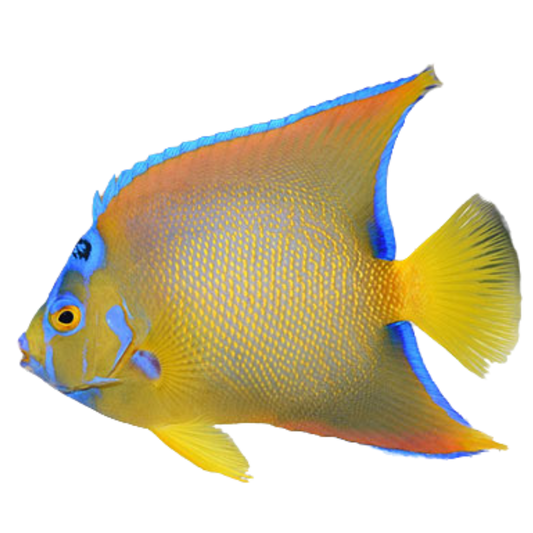
Angelfish are the fish that made me want to collect for a living, and they're still the ones that make me sprint hardest underwater. Every angelfish for sale on this page is a Caribbean species, gathered largely by our own team here in the Florida Keys and rested in our systems before it ships. Here's what I'd want you to know before you pick one.
At a Glance
|
Keep together?
|
One angelfish per tank. They fight their own kind.
|
|
Reef safe?
|
No for the big angels. The cherub only, and only with caution.
|
|
Water
|
75 to 83F, pH 8.1 to 8.4, ammonia and nitrite at zero
|
|
New arrivals
|
Drip acclimate at least 1 hour. It's part of our guarantee terms.
|
|
Shipping
|
UPS overnight from the Keys,
|
|
Experience
|
Cherub is the easiest, rock beauty is the hardest. See the table below.
|
The Angels We Collect
|
Angelfish
|
Adult size
|
Adult tank
|
Reef safe?
|
Experience
|
|
Queen Angelfish
Holacanthus ciliaris
|
About 18 in
|
180 gal or more
|
No
|
Intermediate
|
|
Blue Angelfish
Holacanthus bermudensis
|
About 15 in
|
180 gal or more
|
No
|
Intermediate
|
|
French Angelfish
Pomacanthus paru
|
About 16 in
|
180 gal or more
|
No
|
Intermediate
|
|
Black (Gray) Angelfish
Pomacanthus arcuatus
|
Up to 24 in
|
180 gal or more, biggest of the four
|
No
|
Intermediate
|
|
Rock Beauty Angelfish
Holacanthus tricolor
|
About 10 in
|
100 gal or more
|
No
|
Advanced
|
|
Cherub Pygmy Angelfish
Centropyge argi
|
About 3 in
|
30 gal or more
|
With caution
|
Beginner friendly
|
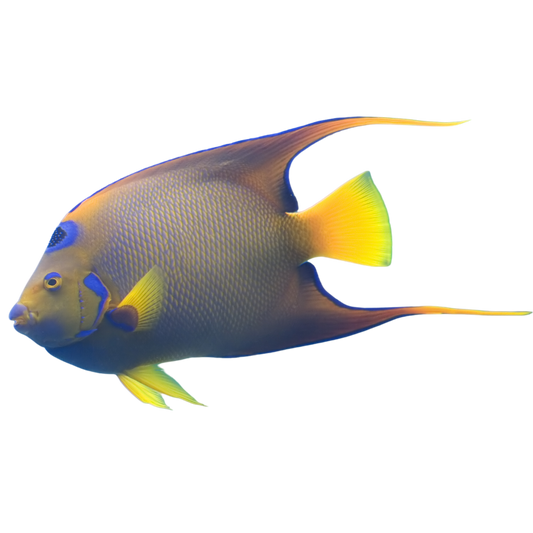
These are the six Caribbean angelfish we work with. The Queen is the showpiece, electric blue and yellow with a dark crown on its forehead. The Blue is her close cousin, no crown and a little more subtle. French angels are famously bold around divers and just as personable in a tank. The Black (gray) angel is the biggest we collect and one of the tougher large angels in the hobby.
The Rock Beauty is a yellow and black stunner with a catch I'll get to below. And the Cherub (Pygmy) is three inches of blue and orange attitude, the one angel here that fits a small tank. Every so often an oddball turns up in our listings too, like a humphead or horned queen, when we cross paths with one out collecting.
Compatibility Notes
Rule one comes straight from the guy who catches them: one angelfish per tank. Though beautiful, they're not schooling fish, and two queens in the same water will fight. I've had customers keep multiples in very large systems, but the rule of thumb is one, and I'll talk you out of buying two.
Rule two: the big angels nip at stony corals, soft corals, sponges, and clam mantles, and a big angel in a stocked reef gets expensive fast. Even a Cherub can decide your polyps are lunch, so watch it. Whatever you pick, add the angel to the tank last so it isn't defending territory from every newcomer.
|
Tankmate
|
Verdict
|
Why
|
|
Tangs and larger Wrasses
|
Good
|
Bold fish that match an angel's energy
|
|
A second Angelfish
|
Skip
|
They aren't schooling fish and will fight
|
|
Seahorses and slow feeders
|
Skip
|
An angel beats them to every scrap of food
|
|
Corals, Sponges, Clams
|
Risky
|
Big angels nip them. The Cherub is the only maybe.
|
Tank Requirements
Be honest with yourself about adult size. A Queen, Blue, French, or Black angel is a 15 to 24 inch fish at maturity, so the long-term home is a six-foot tank. A small juvenile can start out in a 50 to 75 gallon, but buy it knowing an upgrade is part of the deal, because these are long-lived fish. Whatever the size, load the tank with live rock. Angels graze all day and want hiding places to duck into, and a bare tank makes for a nervous fish.
Keep the water inside the ranges in the table up top. Those are the same numbers our live arrival guarantee is written around, and so is the hour of drip acclimation on day one: tank water trickling slowly into the shipping water, never a sudden swap. A calm first day sets the tone for how quickly a new angel settles in and starts grazing.
What to Feed Them
On the reef, these angels graze sponges, algae, and whatever the rock offers, and the closer you get to that, the better the color holds. Feed a sponge-enriched angelfish preparation as the backbone, then rotate in mysis and frozen shrimp, spirulina, marine algae, and nori. Several smaller feedings beat one big one, and mature live rock keeps them busy between meals. Every angel we ship is already eating in our warehouse before it goes in the box.
Juvenile or Adult? The Colors Change
Caribbean Angelfish are basically two different fish in one lifetime. Juvenile French and Black angels are jet black with bright yellow bars, and on the reef the youngsters work as cleaner fish, picking parasites off bigger fish. Young Queens and Blues wear vivid blue bars they'll trade for adult colors, and a juvenile Rock Beauty is nearly all yellow with a black spot that spreads as it grows. Our size listings roughly track those phases.
|
Listing size
|
What you'll see
|
|
Nano and Small (0 to 3 in)
|
Juvenile colors
|
|
Medium (3 to 5 in)
|
Mid-change, adult color coming in
|
|
Large and XL (5 to 8 in)
|
Adult colors
|
Mediums are the sweet spot most customers land on, young enough to settle in easily, old enough that the adult look is showing. If you want to know exactly what phase a specific fish is in, email me and I'll look in the tank.
A Straight Word on Rock Beauties
The Rock Beauty is the most challenging angelfish that we sell to keep healthy and thriving, because so much of its wild diet is sponge. It belongs in a mature tank with plenty of live rock and a keeper who'll commit to sponge-based angel foods, and it's a poor pick for a first marine fish. If you're not sure your tank is ready for one, ask me before you order and I'll tell you straight, even if the answer costs me the sale.
That goes for the whole collection, really. Tell me what's in your tank and I'll tell you which angel fits it best. If a listing shows in stock, that fish is swimming in our warehouse right now, and it ships in a roomy bag straight to your door with more water than it strictly needs. Pick your angel. I'll go catch the next one.
 Sold out
 Sold out
 Sold out
 Sold out